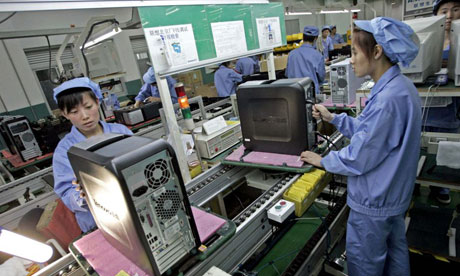
China’s shift from technological nationalism to a more pragmatic strategy of developing national capabilities in conjunction with multinational corporations has transformed its economy. Consistent with this transformation, China has revamped its industrial and technology policies, moving from an isolationist approach aimed at achieving technological independence to become a major producer of computer hardware and a major market for information technology products.
In 1990, China had only 500,000 PCs in a country of more than 1.2 billion people. By 2000, mainland Chinese purchased more than seven million PCs in a single year. During the same time, China’s production of computer hardware grew from less than US$1 billion to US$23 billion.
China’s policies clearly drew on the developmental approach of other Asia- Pacific economies such as Japan, Korea, Taiwan, and Singapore. Each of these became leaders in different segments of the global computer industry through the strong support of government industrial and technology policies.
Several environmental factors have influenced the development of China’s computer industry, shaping
the government’s policy options and affecting the decisions of domestic and foreign firms. The following three are the most crucial.
Mushrooming domestic market
The Chinese government has spurred the growth of the computer hardware market directly by promoting the use of computers, lowering tariffs and thus lowering the price of PCs, and promoting computerization of stateowned enterprises. Observers also indirectly attribute the expansion of the PC market to China’s One-Child Policy and the Chinese belief in education, as many Chinese parents have bought PCs to help their children with schoolwork. Not surprisingly, the Chinese government dangled access to its PC market as a carrot to foreign firms in return for various concessions.
Transitional economy
China’s computer industry developed within the context of the country’s transformation from a centrally planned economy to a mixed or market socialist economy. While other Asian economies have pursued their industry development strategies within a capitalist-market context, China has pursued its strategies in a transitional economy, leading to unusual structures that include both private-capital and state ownership. This intertwining of government and markets makes it difficult to identify the usual distinctions between market
forces and government policy.
Strong technological base
China built its computer industry on the foundation of a large science and technology complex with technological capacities well beyond those of most developing countries. As part of its economic transition, China transformed its science and technology system to spur growth and development. It did so partly by creating stateowned but market-oriented enterprises linked to commercializing the technologies developed in
state-owned research institutions. These enterprises now include the four largest Chinese PC makers: Legend, Founder, Stone, and Great Wall.

No comments:
Post a Comment