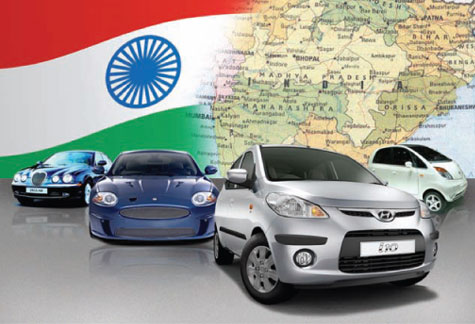
India’s automotive industry is one of the successful cases of India’s economic liberalization strategy set into motion since 1991. The industry which was dominated by a few domestic manufacturers was hardly known for any innovations before 1991, but is now one of the fastest growing manufacturing industries not just in India but globally as well. In 2010, India has emerged as the second fastest growing car market in the world next only to China. Sales of two wheelers crossed 10 million units during the year, a first, with all major two-wheeler manufacturers registering high double digit growth. India in 2010 is the largest tractor manufacturer, second largest two-wheeler manufacturer, fifth largest commercial vehicle manufacturer and the eleventh largest car manufacturer in the world.
There are many instances of innovations in the industry, the Tata’s Nano car being one of the celebrated examples of these innovation efforts. All told, it is an industry that is truly successful in introducing a range of new products not just in the domestic market but in the international market as well.

The auto industry consists of two separate industries: (i) The automobile industry; and (ii) The auto components or parts industry. The automobile industry in turn has three sub sectors: (a) two-wheelers; (b) three-wheelers; and (c) four-wheelers (passenger vehicles and commercial vehicles).

Trends in Production
Production of automobile (in numbers) has doubled itself during the period under consideration. Although the rates of growth of output had plummeted, due essentially to the financial crisis, in 2008-09, it has picked up in all categories the very following year and indications are that this high growth rate will be maintained during
2010-11 as well. There are two important findings. First, is that two wheelers account for the lion’s share of production (in numbers) followed by passenger vehicles (cars). So the driving force behind the spectacular growth of the industry is the output of two-wheelers (motor cycles and scooters) and cars. Second, is that, over time, India has become a base for exports of automobiles. Again most of the exports are accounted for by cars. In fact India has become a base for the manufacture of compact cars.
Trends in Exports
Exports too have registered some appreciable increases. Overall about 11 per cent of the total out is exported although the export intensity varies across the various categories ranging from as high as 24 per cent in the case of three-wheelers to as low as 9 per cent in the case of commercial vehicles. Much of the exports, in quantitative terms, is accounted for by cars and motorcycles reflecting their proportinate share in domestic production. What is interesting is that India has now become base for the manufacture and exports of compact cars.
Structure of the Industry
Here I focus only on the vehicle producing sector. This consists of two sets of firms, domestic and affiliates of a large number of MNCs. Although the industry was largely domestic for a long time, MNCs entry to the industry started with the joint venture Maruti Suzuki’s plans to build small compact cars. Gradually over time, a number of MNCs have established their manufacturing activities in the country. Maruti itself has diluted its domestic equity held by the union government in favour of a larger shareholding by its parent firm. Over time and especially since 1991, there has been entry to the industry by a large number of MNCs. MNCs are focusing much more on passenger cars and motorcycles, while the domestic firms have their presence across
the entire spectrum of vehicles. In terms of total sales the industry is roughly divided between the two the segments although on an average over the last decade or so, the domestic firms have a slightly higher share , as the two large commercial vehicle firms are in the domestic sector.
But on the export front, the foreign firms have not only a higher level but also higher export intensity as well (on an average two times). This shows that the MNCs are actually using India as a base for their exports.