This post is not part of the 20 post which I was required to submit for my Strategic Management course, Though please do check out this video on Disruptive Innovation, it is the 1st video which is part of a series by Clayton Christensen.
Sunday, 4 September 2011

Saturday, 3 September 2011
The Automotive Industry and its Software dependance

The automotive industry faces more pressure to innovate than ever. Traditional markets in the industrialized nations are saturated with vehicles, and customer expectations for innovative functionality are no longer restricted to premium cars. Emerging markets are highly competitive and vehicle makers strive for a competitive edge while aggressively containing costs.Virtually every area of the vehicle faces emerging technologies that add to the cost and complexity of development. Hybrid electrical vehicles and fuel-cell engines are changing the demands on development of power train systems. Active and passive safety features like ABS and Airbags are expected as standard equipment, even in small cars. Further safety improvements require innovative technology such as collision detection systems or night vision. The sophistication of navigation and entertainment systems is also accelerating, across all categories of vehicle. The common factor among all of these new and evolving systems is that they are all heavily dependent on software to function. Software has effectively become the driving force of innovation in many areas of technology and, in particular, in the form of embedded systems in vehicles.
Until the 1970s innovation was built on mechanical or hydraulic components. In September 1968 Citroen introduced their “curve light technology” with a Bowden cable connection between steering wheel and headlight. Bosch introduced the first electronic ABS that was ready for serial production 1978. By 1981, GM was using microprocessor-based engine controls executing about 50 000 lines of code across its entire domestic passenger car production. Since the late 1990s automotive innovation has been mainly based on software. Driver assistance systems like the autonomous cruise control technology that was introduced in 1998 would be impossible without software. This is a clear and continuing trend - according to a study conducted by the Center for Automotive Research, PriceWaterhouseCoopers, VDA and the city of Leipzig, electronics and software accounted for about 16 percent of a vehicle’s total value in 1990, increased to 25
percent by 2001 and by 2018, their share of a car’s total value is expected to climb to almost 55 percent.

As the amount and complexity of software in vehicles continued to grow, OEMs and suppliers realized the importance of software engineering as self-contained engineering discipline. Specific tools emerged to address the particular challenges of software development in the automotive industry. Change management and requirements management systems are well established at most automotive development organizations, as well as version control and configuration management tools. However, the majority of organizations are addressing these challenges with stand-alone or loosely coupled ‘suites’ of tools. This approach to management of the software engineering lifecycle poses significant risks and challenges, including:
> A lack of traceability across entities in the repositories, resulting in errors, rework, risk to quality and significant manual effort;
> Reuse is limited to entities in one repository, inhibiting collaboration and limiting the value of reuse;
> Process and information silos across the organization, which reduces visibility into project status and obscures the impact and cost of change; and
> A lack of support for cross domain product line management.
These outstanding risks and challenges continue to be strong barriers for the industry in general and these can be used as useful focal points for all ongoing endeavors by companies to revamp their businesses to attain a sustainable competitive advantage.
Friday, 2 September 2011
New Technologies threaten existing firms

When do new technologies emerge that overtake existing technologies? What can organizations do to be prepared for such an eventuality and make sure they are not dislodged by new entrants? A framework developed by Clayton Christensen of Harvard Business School provides a good answer. A proven technology improves over a period of time to produce rates of performance improvement well beyond customer needs. When customer needs are more than satisfied, the differentiated offerings of existing players lose their meaning3 . Under such circumstances, if a new technology fares relatively low on some of the currently accepted attributes, but scores heavily on a new attribute, it has the potential to unseat the older technology. Thus, in the disk drive industry, capacity became less important and factors such as physical size and reliability became the important attributes. So, smaller disk drives began to gain popularity.
Many established firms are overtaken by new technology, not because they do not invest sufficiently in research and development, but because their business philosophy and deep rooted culture act as stumbling blocks. As Christensen has explained, they are so much glued to the needs of existing customers that they
overlook what other segments are looking for. Moreover, when overheads are high, there is a tendency not to take seriously new technologies with little revenue or profit potential in the short run. On the other hand, for smaller nimbler rivals, even small markets can be quite lucrative. Consequently, smaller companies who are not glued to the existing customers and who have an open mind, come up with innovations that dislodge well entrenched market leaders. In his book, “Mastering the Dynamics of Innovation,” James Utterback describes the extent to which established players go to resist all efforts to understand new technological developments and instead strengthen their commitment to the older products: “This results in a surge of productivity and performance that may take the old technology to unheard-of heights. But in most cases this is a sign of impending death… Industry outsiders have little to lose in pursuing radical innovations.
They have no infrastructure of existing technology to defend or maintain… Industry insiders… have huge investments in the current technology; emotionally they and their fortunes are heavily bound up in the status quo and from a practical point of view, their managerial attention is encumbered by the system they have – just maintaining and marginally improving their existing systems is a full-time occupation.”
Often the impact of an innovation depends on complementary inventions. Many new components may be needed to develop a larger technological system that can fully exploit the new technology. Laser needed fibre optics, to be used in telecommunications. The computer industry could take off only after the integrated
circuit had been developed. Established companies are handicapped by the tendency to compare the new technologies with the older technologies they are going to replace. They overlook the fact that the cumulative effect of several improvements within a technological system over time can sometimes be immense. Consequently, their commitment to new technologies is often inadequate.
Many companies fail to assess the impact of a new technology. Bell Labs for instance did not think it necessary to apply for a patent covering the use of laser in telecommunications. Only later did it realize what a powerful combination laser and fiber optics made. Inventors, owing to their highly technical orientation, often
fail to assess correctly how the technology will be used. Marconi, the inventor of the radio is a good example. He felt that it would be used between two points where communication by wire would be impossible. Potential users he identified were shipping companies, the navy and newspapers. Marconi, however, failed to
consider the possibility of communicating with several people at the same time. The full potential of a new technology is sometimes recognized only decades later. Take the case of the telephone. Even though the telephone has been around for more than 100 years, only now have applications like voice mail and data
transfer emerged. Identifying uses for new technologies is very difficult. Aspirin, one of the world’s most widely used drugs has been around for 100 years, yet its efficacy in reducing the incidence of heart attack due to its blood thinning properties was discovered only recently.
Thursday, 1 September 2011
Need for Green Innovation in the Auto Industry

The 21 st century brought new concerns and pressures to the way companies innovate. If in the past innovation was predominantly driven by the intention of exceeding customers’ expectation or to create simpler and less costly processes; today many organisations are required to respond to environmental and social demands.
With regard to the environment, the major environmental concerns in the 21st century are: atmospheric pollution (and its consequences for human health, global warming and ozone layer depletion), scarcity of freshwater, raw material and land availability. All these environmental impacts have a great impact on how companies manage their business, and therefore, they are also a driver to innovation. For instance, the availability of land can create a pressure on the prices for land disposal, which “forces” organisations to innovate in order to reducer the waste from their production sites.
Within this new context for innovation management, we would define green innovation as those innovations in the products, processes or in the business model that lead the company to higher levels of environmental sustainability. A higher level of organisational environmental sustainability is reached by the minimisation of environmental impacts, and mainly by, the creation of positive impact on the environment.
Looking back at the history, it is possible to note that the automobile industry has had few radical changes over the last 30 years. However, these few changes were often remarkable and had a significant impact on practice and academia. The mass production, Toyota Production System – “Just in Time” - and the modular consortium are important innovations from the production system perspective. Also, the transfer of the assembly plants to developing countries and global outsourcing are evident changes in the industry’s business and operations strategy. In addition, the automobile industry was the pioneer in the use of robots and it still is the main destination of the use of robotics, still being responsible for 60% of the total utilisation of robots in the world .

Nevertheless, these changes have been insufficient to make the sector more sustainable. As evidence of this the automotive industry is still struggling against economic, environmental and social challenges. The many economic challenges currently facing the industry: notably over-capacity; saturated and fragmenting markets;
capital intensity; and persistent problems with achieving adequate profitability. Strong dependence on fossil fuels and large consumption of raw material lead the environmental problems. As a result, in a near future, it is expected that the sector will face strong pressures and take initiatives in order to reduce the environmental burdens from car use and its production process.
Although the environmental impacts of the automotive industry are spread through out the whole life cycle (e.g. production, use and the end of life of vehicles), the use of the cars is where there is the major energy consumption and emissions. Nevertheless, environmental pressures occur to reduce emissions and waste throughout production, use and end-of-life vehicles.
Tuesday, 30 August 2011
Indian Automobile Industry -- The Macro Picture

India’s automotive industry is one of the successful cases of India’s economic liberalization strategy set into motion since 1991. The industry which was dominated by a few domestic manufacturers was hardly known for any innovations before 1991, but is now one of the fastest growing manufacturing industries not just in India but globally as well. In 2010, India has emerged as the second fastest growing car market in the world next only to China. Sales of two wheelers crossed 10 million units during the year, a first, with all major two-wheeler manufacturers registering high double digit growth. India in 2010 is the largest tractor manufacturer, second largest two-wheeler manufacturer, fifth largest commercial vehicle manufacturer and the eleventh largest car manufacturer in the world.
There are many instances of innovations in the industry, the Tata’s Nano car being one of the celebrated examples of these innovation efforts. All told, it is an industry that is truly successful in introducing a range of new products not just in the domestic market but in the international market as well.

The auto industry consists of two separate industries: (i) The automobile industry; and (ii) The auto components or parts industry. The automobile industry in turn has three sub sectors: (a) two-wheelers; (b) three-wheelers; and (c) four-wheelers (passenger vehicles and commercial vehicles).

Trends in Production
Production of automobile (in numbers) has doubled itself during the period under consideration. Although the rates of growth of output had plummeted, due essentially to the financial crisis, in 2008-09, it has picked up in all categories the very following year and indications are that this high growth rate will be maintained during
2010-11 as well. There are two important findings. First, is that two wheelers account for the lion’s share of production (in numbers) followed by passenger vehicles (cars). So the driving force behind the spectacular growth of the industry is the output of two-wheelers (motor cycles and scooters) and cars. Second, is that, over time, India has become a base for exports of automobiles. Again most of the exports are accounted for by cars. In fact India has become a base for the manufacture of compact cars.
Trends in Exports
Exports too have registered some appreciable increases. Overall about 11 per cent of the total out is exported although the export intensity varies across the various categories ranging from as high as 24 per cent in the case of three-wheelers to as low as 9 per cent in the case of commercial vehicles. Much of the exports, in quantitative terms, is accounted for by cars and motorcycles reflecting their proportinate share in domestic production. What is interesting is that India has now become base for the manufacture and exports of compact cars.
Structure of the Industry
Here I focus only on the vehicle producing sector. This consists of two sets of firms, domestic and affiliates of a large number of MNCs. Although the industry was largely domestic for a long time, MNCs entry to the industry started with the joint venture Maruti Suzuki’s plans to build small compact cars. Gradually over time, a number of MNCs have established their manufacturing activities in the country. Maruti itself has diluted its domestic equity held by the union government in favour of a larger shareholding by its parent firm. Over time and especially since 1991, there has been entry to the industry by a large number of MNCs. MNCs are focusing much more on passenger cars and motorcycles, while the domestic firms have their presence across
the entire spectrum of vehicles. In terms of total sales the industry is roughly divided between the two the segments although on an average over the last decade or so, the domestic firms have a slightly higher share , as the two large commercial vehicle firms are in the domestic sector.
But on the export front, the foreign firms have not only a higher level but also higher export intensity as well (on an average two times). This shows that the MNCs are actually using India as a base for their exports.
Monday, 29 August 2011
Understanding the reasons behind Disruptive Innovation

I focus mostly on the disruptive innovations in the technology space ( in keeping with my editorial policy) , and talk about my understanding of the underlying reasons for disruptive innovations seen in the world over the last few years.
The term ‘disruptive innovation’ has been used to describe innovation that is of highly revolutionary or discontinuous nature, in which customers and consumers embrace new paradigms in favour of the old. To begin to understand disruptive innovation it is useful to consider some examples such as the light-bulb industry’s disruption of the candle industry and the desktop computer industry’s disruption of the mainframe and minicomputer computer industries.That firms need to periodically engage in the process of revolutionary or disruptive innovation for long-term survival is well-recognised. Many companies can and do spend heavily on technology development and market research, however, almost all investment is devoted to evolutionary innovations that make current offerings perform better in ways customers already value. Few organisations understand or have established track records for undertaking successful disruptive innovation, in fact most are reluctant to follow this path and find themselves disadvantaged by embedded structures, capabilities and outlooks. The desire to maintain a stable and efficient context to satisfy mainstream market demands, forces many organisations into a focus on the ‘familiar’, the ‘mature’ and the ‘proximate’. Thus most organisations fall into learning traps preventing them from ‘exploring’ potentially disruptive ideas .
If an organisation manages to foster a potentially disruptive idea, not only does it often face huge problems getting internal support but there are massive obstacles to overcome to get it adopted by the mass market.
New paradigms represent discontinuities in trajectories of progress as defined within earlier paradigms - where a technological paradigm is a pattern of solutions for selected technological problems . In fact, new paradigms redefine the future meaning of progress and a new class of problems becomes the target of normal incremental innovation. Thus for a discontinuous innovation to be disruptive, successful exploitation is vital, which, results in significant transformation of the mainstream market and its value proposition.
The extent of disruption that major breakthroughs cause can be broken down into subgroups of ‘product’ and ‘process’, furthermore, these can be either ‘competence destroying’ or ‘competence-enhancing’. Competencedestroying discontinuities are highly disruptive, requiring new skills, abilities and knowledge, are initiated by new entrants – or spin-off companies. They increase environmental turbulence and market uncertainty, usually delivering a new product class, a significant product substitute or a radical new way of making a product. Alternatively, competence-enhancing discontinuities “represent an order-of-magnitude improvement over prior products, yet build on existing know-how”. They are associated with little or even decreased environmental turbulence and reduced market uncertainty. Thus, disruptive innovation occurs in both products and processes and is at the extreme end of the continuum of discontinuous innovation.

The system level is where the real benefits of ‘non-linear’ or disruptive innovation can be found. He states that organisations can disruptively innovate with products or services but the real value is only unlocked when the larger system is factored into the disruption. By unpacking the ‘business model’ and exposing it to disruptive thinking, Hamel states that ‘Business Concept Innovation’ occurs and that this is the real essence of revolutionary innovation, causing disruption to preconceived ideas, markets and entire value networks.
Thus, revolutionary innovations fall onto a continuum ranging from ‘radical incrementalism’ – that delivers significant change to the mainstream customer which, is mostly competence enhancing with low environmental turbulence and low market uncertainty - to ‘disruptive innovations’ – that deliver transformational change to the mainstream market and its value attributes which, are mostly competence destroying with high environmental turbulence and high market uncertainty.
Friday, 26 August 2011
How is Innovation in Computer industry different?

The PC industry has introduced many innovations in its 25 year history. Product innovation includes the creation of new product categories such as notebook PCs and PDAs, as well as the creation of new product platforms such as multimedia PCs and wireless “mobility” notebooks. The scope and outcome of product innovation in PCs is shaped by the presence of global architectural standards set originally by IBM and now
largely controlled by Microsoft and Intel. Common interface standards enable innovators to reach a global market with standard product lines; thus economies of scale can be achieved to support investments in product development and manufacturing capacity. This is different from industries such as mobile phones or video games, in which multiple incompatible standards exist. An example of the benefits of standardization is the acceptance of 802.11 as a common standard which spurred the introduction of wireless networking as a standard feature on notebook PCs. On the other hand, standardization battles can constrain innovation as PC makers are reluctant to incorporate technologies before a standard is set, as is the case with second generation DVD technology.
When PC makers do innovate, they face hard choices in trying to capture profits from their innovations. One alternative is to incorporate the innovation only in their own products to differentiate their PCs from those of competitors, but there is a question of whether they can convince customers to pay for the differentiation and also whether customers will want to adopt a non-standard technology. Another is to license the technology broadly, which might bring in license fees and even establish the technology as an industry standard, but will eliminate product differentiation.
Despite these challenges, which may discourage radical innovation, PC makers are pushed to incremental innovation by component makers who introduce frequent changes in their products (faster speed, greater capacity, smaller form factor, longer life) in efforts to gain greater market share within their industry sector such as semiconductors, storage or power supply. PC makers feel they have to adopt these changes rather than risk being left behind by a competitor that does adopt. One PC maker expressed the view that it would be better for everyone if the pace of innovation were slower, but no one is willing to take the risk of such a slowdown. Thus, competition and innovation in the supply chain tends to push PC makers into incremental changes that do little to differentiate products.
As a result, PC makers have tended to concentrate on operational efficiency, marketing, and distribution, rather than trying to use product differentiation as a source of sustainable competitive advantage. Product innovation at the system level tends to be incremental and emphasizes developing slightly different products for
narrowly defined market niches, such as PC gamers who demand high performance or business travelers who desire ultra-light notebooks, rather than more distinctively innovative products. Instead, most product innovation occurs upstream in components and software, which are then incorporated by PC makers.
Thursday, 25 August 2011
Analysing China’s Computer Industry
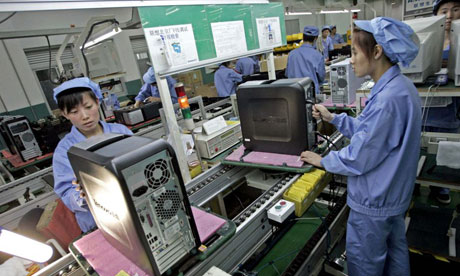
China’s shift from technological nationalism to a more pragmatic strategy of developing national capabilities in conjunction with multinational corporations has transformed its economy. Consistent with this transformation, China has revamped its industrial and technology policies, moving from an isolationist approach aimed at achieving technological independence to become a major producer of computer hardware and a major market for information technology products.
In 1990, China had only 500,000 PCs in a country of more than 1.2 billion people. By 2000, mainland Chinese purchased more than seven million PCs in a single year. During the same time, China’s production of computer hardware grew from less than US$1 billion to US$23 billion.
China’s policies clearly drew on the developmental approach of other Asia- Pacific economies such as Japan, Korea, Taiwan, and Singapore. Each of these became leaders in different segments of the global computer industry through the strong support of government industrial and technology policies.
Several environmental factors have influenced the development of China’s computer industry, shaping
the government’s policy options and affecting the decisions of domestic and foreign firms. The following three are the most crucial.
Mushrooming domestic market
The Chinese government has spurred the growth of the computer hardware market directly by promoting the use of computers, lowering tariffs and thus lowering the price of PCs, and promoting computerization of stateowned enterprises. Observers also indirectly attribute the expansion of the PC market to China’s One-Child Policy and the Chinese belief in education, as many Chinese parents have bought PCs to help their children with schoolwork. Not surprisingly, the Chinese government dangled access to its PC market as a carrot to foreign firms in return for various concessions.
Transitional economy
China’s computer industry developed within the context of the country’s transformation from a centrally planned economy to a mixed or market socialist economy. While other Asian economies have pursued their industry development strategies within a capitalist-market context, China has pursued its strategies in a transitional economy, leading to unusual structures that include both private-capital and state ownership. This intertwining of government and markets makes it difficult to identify the usual distinctions between market
forces and government policy.
Strong technological base
China built its computer industry on the foundation of a large science and technology complex with technological capacities well beyond those of most developing countries. As part of its economic transition, China transformed its science and technology system to spur growth and development. It did so partly by creating stateowned but market-oriented enterprises linked to commercializing the technologies developed in
state-owned research institutions. These enterprises now include the four largest Chinese PC makers: Legend, Founder, Stone, and Great Wall.
Wednesday, 24 August 2011
Commercializing New Technologies

Successful technology management is all about bringing a new concept to the market in the most efficient way. To commercialize an idea successfully, a number of different stages must be completed, each more difficult than its predecessor. Not only must each of these stages be completed successfully, but adequate resources
mobilized to facilitate transition from one stage to the next.
• Imagining: Developing the initial insight about the market opportunity for a particular technical development.
• Incubating: Nurturing the technology sufficiently to gauge whether it can be commercialized.
• Demonstrating: Building prototypes and getting feedback from potential investors and customers.
• Promoting: Persuading the market to adopt the innovation.
• Sustaining: Ensuring that the product or process has as long a life as possible in the market.
The first three stages obviously cannot be managed like an ordinary business with tight controls. So they have to be fostered and nurtured in an environment which is culturally quite different from normal corporate settings.
Chan Kim and Renee Mauborgne (Harvard Business Review, September-October 2000) offer a useful framework for commercializing technological innovations. They feel that organizations must address three important issues. What is the likelihood that customers will be attracted to the new technology? What is the price that will attract the largest number of customers? Will the new technology evolve into or help in building a profitable business? Successful innovators focus on how the new product or service will affect customers. They look at the various stages of customer experience like purchase, delivery, use, maintenance and disposal. They also consider the utility of the product in terms of environmental friendliness, convenience, simplicity and customer productivity. In other words, they orient product development activities towards the customer rather than the technology. The price chosen by the innovator has to attract and retain a sufficiently large number of customers. Innovations very often compete with other products which may look quite dissimilar but perform the same function. What is important here is how people will compare the new product with other very different-looking products and services. The price level will also depend on the ease of imitation. If the product is difficult to imitate or well protected by patents, a high price is possible. On the other hand, if imitation is easy, a low price becomes essential.
Successful innovators understand the importance of generating positive cash flows as quickly as possible. They generate profits not by raising price but by keeping costs tightly under control, consistent with the chosen price level. They improve materials selection, simplify design processes and improve manufacturing efficiencies to cut costs. They may also consider strategic outsourcing of non core activities. Moreover, innovators compensate for their lack of technological capabilities in some areas by partnering and forming alliances. In spite of all these moves, if the price is still high and beyond the reach of target customers, they look at options such as leasing or renting the product on a time share basis, which are more appealing to customers.
Tuesday, 23 August 2011
The Strategic Role of the Contact Center in High Technology
Although participating in a commodity business, high-tech companies cannot focus on running their contact centers primarily as cost centers to provide acceptable levels of technical support. In today’s competitive market, contact centers are an even greater strategic asset for survival and will have to go the extra mile to deliver value.
Contact centers are a way to improve the quality of customer service to help differentiate themselves. Fundamental customer service goals that should be delivered by today’s contact center include cross-selling and up-selling more products and services by understanding customer needs, and running more cost efficient operations by increasing agent productivity. Further, contact centers are now considered a key instrument in changing the public’s perception of a company, creating a great customer experience and executing on the business goals of the company as a whole.

How can your contact center accomplish these service objectives? Depending on contact center maturity and business requirements, here I suggest one contact center strategy to make these goals a reality
Facilitate Integrated and Consistent Cross-Channel Interactions
The first step in offering an exceptional customer experience is to offer multi-channel contact center interactions comprised of phone, fax, e-mail, SMS, and perhaps even Web chat, so that prospects and customers can conduct business with you exactly when and how they like.
With one view of the customer across all interaction channels, high-tech companies are able to deliver better service, improve cross-sell and up-sell rates and lower operating costs. Providing customers with a seamless experience across all channels ensures that their interactions are as consistent and efficient as possible, which will help build a solid relationship with the customer. Sharing custom data across channels helps create a more complete customer profile which can be used to identify cross-selling opportunities. And, streamlining data exchange and supporting collaboration across all channels promotes operational efficiency.
For relationship selling, service representatives require a unified view of interactions across all channels to effectively promote and sell services. In the early promotional stage, this means ensuring that high-tech companies don’t repeat turned-down offers to customers at different touch points, such as the call center and the Web. As the customer responds to the promotion, customer service representatives can pick up where the customer left off at each stage in the sales process, regardless of which channel the customer was using.
Monday, 22 August 2011
The Key Challenges Facing the High Technology Industry
The Customer Experience is Becoming Even More Important
Long gone are the high-flying days of the dot-com bubble. Today, high-tech companies have to fight long and hard to win business from consumers, as economic downturns give buyers even more power. Competition further pressures profit margins and commoditization makes it difficult for vendors to pursue a premium pricing strategy. To stay competitive and profitable, high-tech companies must provide quality customer service to differentiate their business and to reinforce their brand image.
Despite the acknowledged importance of customer service, the high-tech industry suffers from a high degree of customer dissatisfaction in this area.
Further, one high-tech sector — PC manufacturing — scored a 64 on call center satisfaction in a CFI Group survey, the lowest customer satisfaction score of all the industries surveyed, which included catalog sales, banking, cell phone service and cable and satellite TV providers. Also, according to the CFI Group survey, nearly a quarter of all callers hang up before their issue is resolved.
To Drive New Sales, High-Tech Companies Must Find New Ways to Reach Customers
For a variety of reasons, high-tech companies are having difficulty maintaining high growth rates. For example, trade shows, trade publications and direct mail deliver a fraction of the return on investment they did in years past. And the rate of online retail sales is slowing, as consumers are experiencing Internet fatigue and changing their buying habits. This is particularly problematic for computer hardware and software vendors who generate more than 40% of their sales on the Internet. To compensate, relationship building and cross-selling and up-selling of supplemental features, products and services are critical. To identify sales opportunities, high-tech companies should take advantage of every customer interaction in the contact center and do a better job of understanding customer behavior.
Inbound contact for service, both phone and Web-based, are often overlooked as chances to generate additional revenue. While these interactions provide excellent context to cross-sell and up-sell extended warranties and additional products and services, technology support centers are rarely equipped to close deals.
Beyond the technical support center, many high-tech companies may be losing sales by their inability to provide relevant information or assistance to customers who shop online. What’s more, attracting new customers is difficult because high-tech companies have trouble recognizing the demographic segments likely to become early adopters of new products, and customer retention is less than it should be because of failure to notify customers about contract and lease expirations.
Long gone are the high-flying days of the dot-com bubble. Today, high-tech companies have to fight long and hard to win business from consumers, as economic downturns give buyers even more power. Competition further pressures profit margins and commoditization makes it difficult for vendors to pursue a premium pricing strategy. To stay competitive and profitable, high-tech companies must provide quality customer service to differentiate their business and to reinforce their brand image.
Despite the acknowledged importance of customer service, the high-tech industry suffers from a high degree of customer dissatisfaction in this area.
Further, one high-tech sector — PC manufacturing — scored a 64 on call center satisfaction in a CFI Group survey, the lowest customer satisfaction score of all the industries surveyed, which included catalog sales, banking, cell phone service and cable and satellite TV providers. Also, according to the CFI Group survey, nearly a quarter of all callers hang up before their issue is resolved.
To Drive New Sales, High-Tech Companies Must Find New Ways to Reach Customers
For a variety of reasons, high-tech companies are having difficulty maintaining high growth rates. For example, trade shows, trade publications and direct mail deliver a fraction of the return on investment they did in years past. And the rate of online retail sales is slowing, as consumers are experiencing Internet fatigue and changing their buying habits. This is particularly problematic for computer hardware and software vendors who generate more than 40% of their sales on the Internet. To compensate, relationship building and cross-selling and up-selling of supplemental features, products and services are critical. To identify sales opportunities, high-tech companies should take advantage of every customer interaction in the contact center and do a better job of understanding customer behavior.
Inbound contact for service, both phone and Web-based, are often overlooked as chances to generate additional revenue. While these interactions provide excellent context to cross-sell and up-sell extended warranties and additional products and services, technology support centers are rarely equipped to close deals.
Beyond the technical support center, many high-tech companies may be losing sales by their inability to provide relevant information or assistance to customers who shop online. What’s more, attracting new customers is difficult because high-tech companies have trouble recognizing the demographic segments likely to become early adopters of new products, and customer retention is less than it should be because of failure to notify customers about contract and lease expirations.
Sunday, 21 August 2011
The ladder of government intervention
In times of crises, many a times and often governments have to swallow the bitter pill and take hard decisions, now with regards to the Automobile industry I propose ' a ladder of intervention' which I discuss below.
Virtually every Western government with a sizeable domestic automotive industry has intervened in some way or another during the 2009 economic crisis. As problems with individual companies worsened, governments have found themselves climbing this ladder quite rapidly.
1) Credit warranties: This is the least controversial form of intervention. Most countries have initiated schemes to guarantee or extend credit, and these are typically not limited to the automotive industry. A popular approach to support the automotive industry is to earmark loans for R&D or vehicle development to boost fuel efficiency or to secure the loan with company land or buildings.
2) Recapitalize financing units: Recapitalization is similar to credit warranties and to interventions in the banking sector, with an important difference that there is often very little or no equity participation by governments. The fall in both new and used vehicle demand forced large losses at financing units active in the leasing market. Compared with banks or other financial institutions, there are few retained earnings in automaker’s credit arms to strengthen the company’s equity position, because earnings are passed on to keep manufacturing units afloat.
3) Purchase subsidies for consumers: Providing purchase subsidies directly to the consumer benefits automakers and suppliers, stimulates the broader economy, and is easily monitored. In most countries, rules were put in place to yield environmental benefits as well. The macroeconomic effect of these programs has been large, but they are proving to be a drag on sales recovery.
4) Provision of working capital and interfering with management: The direct injection of working capital to specific companies is unlikely to come without policymakers gaining some influence over decision-making, although governments have been at pains to stress that they were not interfering with the day-to-day operations of firms and that they plan to sell their stakes at the first opportunity.
5) Takeover liabilities: This is similar to the provision of working capital without the expectation that the loans will ever be repaid. In this case, governments become even more extensively involved in the management of the firm. While these cash infusions are technically structured as loans, there is often no real expectation of repayment.
6) Quasi-nationalization: As part of the “quick bankruptcy” procedure of Chrysler and GM, the U.S. (and Canadian) government took large equity stakes in the restructured companies in exchange for debtor-in-possession financing. At this point, government intervention in strategic decision making became more explicit: appointing new top management, demanding larger wage cuts, restructuring of the product portfolio, and insisting on additional plant closures. The stated objective is to sell government ownership shares as soon as possible, but before this can happen it will have to be clear that the companies are financially stable.
Virtually every Western government with a sizeable domestic automotive industry has intervened in some way or another during the 2009 economic crisis. As problems with individual companies worsened, governments have found themselves climbing this ladder quite rapidly.
1) Credit warranties: This is the least controversial form of intervention. Most countries have initiated schemes to guarantee or extend credit, and these are typically not limited to the automotive industry. A popular approach to support the automotive industry is to earmark loans for R&D or vehicle development to boost fuel efficiency or to secure the loan with company land or buildings.
2) Recapitalize financing units: Recapitalization is similar to credit warranties and to interventions in the banking sector, with an important difference that there is often very little or no equity participation by governments. The fall in both new and used vehicle demand forced large losses at financing units active in the leasing market. Compared with banks or other financial institutions, there are few retained earnings in automaker’s credit arms to strengthen the company’s equity position, because earnings are passed on to keep manufacturing units afloat.
3) Purchase subsidies for consumers: Providing purchase subsidies directly to the consumer benefits automakers and suppliers, stimulates the broader economy, and is easily monitored. In most countries, rules were put in place to yield environmental benefits as well. The macroeconomic effect of these programs has been large, but they are proving to be a drag on sales recovery.
4) Provision of working capital and interfering with management: The direct injection of working capital to specific companies is unlikely to come without policymakers gaining some influence over decision-making, although governments have been at pains to stress that they were not interfering with the day-to-day operations of firms and that they plan to sell their stakes at the first opportunity.
5) Takeover liabilities: This is similar to the provision of working capital without the expectation that the loans will ever be repaid. In this case, governments become even more extensively involved in the management of the firm. While these cash infusions are technically structured as loans, there is often no real expectation of repayment.
6) Quasi-nationalization: As part of the “quick bankruptcy” procedure of Chrysler and GM, the U.S. (and Canadian) government took large equity stakes in the restructured companies in exchange for debtor-in-possession financing. At this point, government intervention in strategic decision making became more explicit: appointing new top management, demanding larger wage cuts, restructuring of the product portfolio, and insisting on additional plant closures. The stated objective is to sell government ownership shares as soon as possible, but before this can happen it will have to be clear that the companies are financially stable.
Saturday, 20 August 2011
Reasons justifying Government interventions in the Auto industry during the recent financial crisis

During the 2009 economic crisis nearly all sectors experienced reduced sales and firms teetering on the edge of, or falling into bankruptcy, but only in the banking sector did the government intervene at a larger scale than it did in the automotive industry. The systemic importance of the banking sector explains the motivations for interventions there, but why the automotive industry? I believe there are six reasons:
1) Intervention is believed to be feasible and manageable: The automotive industry is extremely concentrated at the top. Lead firms are very large and few in number and the value chain is structured in a clear, hierarchical way. As a result, government officials believe they can effectively assist the industry by propping up lead firms, and in turn continue to generate business for thousands of the upstream suppliers.
2) Political sensitivity is acute: Large bankruptcies can create political reactions in any industry or country, but large, regionally concentrated employment in the automotive sector, the iconic status of passenger vehicles, and strong labor unions made it all the more difficult for politicians to let large firms in this sector fail, especially at a time when the aggregate labor market was very weak.
3) Multiplier effects boost the rationale for automotive industry bailouts: The notion of multiplier effects was frequently evoked as a justification for bailing out automakers. While it is misleading to present these as indirect job creation, bailouts can minimize the increase in cyclical unemployment over the short term.
4) Stimulating vehicle demand is seen as an effective way to stimulate aggregate demand: Customers can alter the timing of vehicle purchases more easily than most other purchases. Purchasing a new vehicle is often a discretionary decision, usually made when the household still has a working existing vehicle. While this causes sales declines to be larger at the start of recessions (triggering calls for intervention), it also makes demand-stimulus interventions quite effective, because consumers can also move purchases forward.
5) Stimulating vehicle demand has environmental side-benefits: The high fuel prices of the summer of 2008, along with rising concern over carbon emissions, awakened politicians, once again, to the importance of reducing the consumption of fossil fuels. Policy measures have included CO2 taxes, higher fuel efficiency standards, and R&D for technology development.
6) Bailing out automakers helps to solve credit problems: In most countries, the bulk of vehicle sales are financed (90 percent in the United States). Tightening credit conditions for customers made it much harder to obtain vehicle financing than in normal circumstances. The operations of GM and Chrysler are deeply intertwined with their finance companies, and often depend on them for profits. The difficulty for these firms to obtain credit themselves made it impossible for them to provide consumer financing, and hampered their usual role in financing working capital (i.e., vehicle inventories) in dealership networks.
Because the policy objectives, justifications, and motivations for interventions and bailouts have been so numerous, and the actions taken so swift and complex, it is hard to evaluate them. No single criterion – the rescue of an individual firm, the slowing of unemployment, the repair of credit markets, the reduction of carbon emissions, or stimulation of aggregate demand – can be used as a measure of success. Clearly, policies that seek to achieve multiple objectives are laudable, but the debate has been muddied because different objectives and outcomes have been emphasized by different policymakers and with different constituencies. With so many possible goals and measures to choose from, it is easy to claim success or failure based on political expediency.
Friday, 19 August 2011
The automotive industry in the 2009 economic crisis
Here I discuss the impacts of the 2009 Global Financial crisis on the Auto industry, in one of the subsequent posts on this blog I would discuss the ramifications and justifications for the government interventions in the Auto industry.
The global financial crisis that began in the fall of 2008 severely deepened an ongoing global economic recession that had been underway since early in the year. The impact of the crisis on the automotive industry has been more severe than for any other industry except housing and finance. There are several reasons for this.
First, the industry, especially the value chains led by the American Big 3 automakers, was in a dire state to begin with. For companies already on life-support, the freezing of credit markets meant cancelled orders, unpaid supplier invoices, and ‘temporarily’ shuttered plants. Huge debt loads, high fixed-capital costs, high labor costs, and immense pension and health care commitments to retirees added to the immediacy of the damage. Second, the high cost and growing longevity of motor vehicles prompted buyers to postpone purchases that they might have otherwise made. Consumers, especially in the world’s largest national passenger vehicle market, the United States, found it difficult to obtain loans for purchase and, driven by fear of job loss, moved aggressively to increase their rate of saving. Vehicle sales plunged and as a result, beginning in the fall of 2008, pushing the industry into its most severe crisis since the Great Depression.
Because of the co-location of assembly and parts plants in national and regional production systems, the effects of the crisis have been largely have been contained within each country/region. For example, the largest sales decline was experienced in the United States. While this had a dramatic effect on parts imports, which declined at an average annual rate of 20.2% over the 2008-2009 period (US International Trade Commission), the more severe impact of the crisis in the US was on assembly and parts plants within North America, some of which not only ceased importing parts, but temporarily or even permanently closed.
In this environment, the United States Congress, supported by a new administration unwilling to preside over the liquidation of the country’s largest manufacturing industry, offered several waves of bailouts, but only after a series of humiliating Congressional hearings where Big 3 CEOs made the case for government assistance and were aggressively cross-examined about management’s culpability for the crisis. In the aftermath, General Motors’ CEO resigned and the company was forced to file for Chapter 11 bankruptcy. Chrysler also filed for bankruptcy, and narrowly avoided a break-up through partial liquidation and sale of its more lucrative assets to the Italian automaker Fiat, which is providing technology and management support in an effort to restructure the company to make it viable again.
While it is widely believed that Ford has not yet asked for or received government assistance, the company did accept a $5.7 billion ‘retooling loan’ from the Department of Energy to develop more fuel efficient cars and trucks in June 2009.
In Europe too, bailouts were provided, but in different ways. Credit support and loan guarantees were given directly to troubled firms. Scrappage or environmentally-motivated subsidies were given to consumers to boost industry sales and help firm indirectly.
Thursday, 18 August 2011
The long-term chances of innovations in the Auto industry
The worldwide megatrends in politics, societies, economies and technology define the requirements that future cars will have to fulfill – and these will affect almost every aspect of the automobile. Here I talk about two of these megatrends, and how I believe these will pan-out in the years to come
1. Cars for an aging population

In the majority of markets, the average new-car buyer is 40 years old. By 2015, that age is expected to increase by four years. Developing cars for this target group does not mean building “old-age cars.” It means equipping cars with design and handling features that the target group will find useful, exciting and desirable – without sacrificing the model’s overall statement. A car designed for an older target group might feature:
· Ergonomically designed boarding, loading and seating solutions
· Visual aids for better night and rain vision
· Easy-to-use functions even for complicated devices
· Timeless design features
· Speed and special attention recommendation displays
· Side and rear-view cameras
· Customized mobility services
2. New cars for megacities
In 2015, 40 percent of the world population will live in cities with more than one million residents, 17 percent will live in megacities with more than five million residents. The cruising speed in these cities will average not more than six miles per hour while the typical driver will use his or her car three hours a day. Car design for this environment will take a very different approach from that of current vehicles. Some new focal points will be:
· Easy switching between relaxation and driving positions
· Emphasis on passenger entertainment and information systems
· Automation of stop-and-go traffic situations
· Concealment of passengers from outside viewers
· Protection of passengers from attacks
· Effective smog protection and air conditioning
· Nearly zero emissions
Implementation
Now we look at how firms can take advantage of these trends and thereby implement strategies to take advantage of these trends
Individual companies should analyze these trends with a focus on their specific product range and aims. Analyzing the direction and speed of market changes, and anticipating future customer needs will shift the focus of the entire organization: Long-term corporate targets become clearer and far more important, and the innovation focus widens from incremental improvements to system innovations.
Recognize technology chances and manage the risks
A closer look at R&D spending by both OEMs and suppliers shows that around 40 percent of all investments go into innovations that never make it into the car or are never produced in sufficient numbers due to a lack of market acceptance. Of the remaining 60 percent, 20 percent is for necessary serial development. Another 20 percent is for innovations that fulfill legal requirements but do not add to a product’s distinctiveness. Usually, these innovations do not pay off either. That leaves only a small remainder of 20 percent that represents profitable innovation investment. And more and more technologies are fiercely fighting over this sweet spot.
Only around ten percent of the automotive technologies under development at the moment have the potential to become blockbuster innovations. These technologies combine the two most relevant categories: The first category, market potential, consists of functional purpose, customer acceptance, regulation compliance and price level. The other category, a high degree of innovation, creates technological differentiation in the market, better intellectual property protection, high margins and a long harvest period.
However, blockbuster technologies come at a high risk. The bigger the innovation step, the higher the development risks. And market potential is a moving target. Take the fuel cell. It certainly is highly innovative compared with existing power-train concepts. But it has a very low market potential at the moment, given its still questionable road capability, uncertain price position and dependence on special fuels. However, this situation could change with time and turn the fuel cell into a true blockbuster.
Automotive companies must increasingly focus their innovation efforts on a very limited number of promising projects. In order not to place their bets blindly, they have to carefully assess the potential and risks of the technologies they want to explore and regularly reassess them.
Wednesday, 17 August 2011
My Take on Global Sourcing in the Auto Industry
With the coming of the “ Mega Competition ” era, the world auto industry is entering the wave of globalization. Companies are approaching the 21 century, and they are realizing that global thinking
and management are critical for the survival of the auto industry.

The contents of global strategy of auto industry consist of global car production and allocation strategy, global sourcing strategy, and global product development strategy. Managing globalization is also one of the key issue from the view point of making strategic decision. On the other hand managing globalization is closely related with managing localization. Pursuing global strategy, all of the auto companies have to solve this problem: how they can co-ordinate and connect their global strategy with their strategy of
localization.
The historical tendency of most of the world auto enterprises was consolidated organization of local companies such as U.S. Big 3 and some Europeans. Their local subsidiaries developed their differentiated local product by themselves and purchased local parts by their own way.
Since 1986, Japanese car makers set up local transplants by different ways in Western countries. In early steps of this process, Japanese car manufacturers tended to transfer their production and part procurement systems and their products with some local modifications. In 1990s, they were confronted with higher Yen' appreciation and the rationalization of their production. During this term their strategy has been changed gradually from local oriented one to more global oriented one. They tried to build a local production network linked to the international division of labour. The local production network tended to produce international products which can be exported to the world and finally to go to the global network.
These network global strategies were pursued not only by car assemblers but also by part suppliers. Japanese part suppliers supported car assembler' localization and later their global networking because they were also entering globalization. After 1990, this globalization has been more accelerated.

Within the context of the Japanese auto makers' plan for establishing a global network, western auto makers plan to strengthen their global networking strategy to greater localize their production and marketing, and to organize as a world-wide network particularly for auto exports. An aggressive stance toward the development of global strategy involves producing more goods locally and purchasing a greater number of parts internationally. US and European auto makers have taken the lead in global integration of product development and parts purchases. A few examples of such companies would be the new "World Car Concept", which combines global-wide automobile product development with global sourcing.
Of course some companies cannot use special term "world car" in their global strategy. There are several choices, however, in approaching the "world car", such the "localized design car". Even without a "world car", auto companies should consider the possibility of global sourcing. As auto companies strategy becomes more globalized, their parts sourcing strategy are evolving.
Global sourcing means purchasing parts and components from optimal places which are characterised by global bases. Why and how has global sourcing emerged? With the coming of borderless economy, we can now overview which area is most optimal to purchase some parts and components by quality, cost, delivery, and engineering capability. We can watch the cost disparity by each countries using computer
information data base. Although exchange rate and currency evaluation are still unstable, observing these data can show the best response and new choices of exchange rate free purchasing.
FUTURE PROSPECT OF "WORLD CAR" OR "ASIAN CAR", GLOBAL SOURCING AND CHANGING GLOBAL PRODUCT STRATEGY
The tendency of global networking for local production is spreading not only among Japanese car makers but among GM, Ford and European makers such as VW, BMW and Mercedes Benz. Among these makers the most attractive plan is Ford' ambitious "World Car strategy" and "Global Sourcing strategy".
Ford publicized Ford 2000 project as its 21st Century' grand strategy with new world car strategy. In this project Ford exhibited its grand design targets as follow:
• Advancing effectiveness by global integration of Auto R&D, Design and Production.
• Reorganization and vitalization of bureaucratic organization.
• Active entrance for new developing market like China, India, Latin America and ASEAN countries. Strengthening established market share.
• Global advancing R&D cost cutting and quality improvement by suppliers integration.
• For this global strategy, Ford has to integrate its R&D center globally, and introduced 5
Vehicle Centers.
Not only globalization strategies by Ford and GM but also by Japanese auto makers and global sourcing suppliers such as Mitsubishi and Denso are also interesting story with step by step approach with localization.
Tuesday, 16 August 2011
Managing Disruptive Technologies
Technological performance often overshoots market requirements. Consequently, today’s under-performing technology may meet the needs of customers tomorrow. On the other hand, technologies which perform satisfactorily today may over-perform tomorrow and customers may not be willing to pay for this over performance. As Christensen puts it, “In their efforts to stay ahead by developing competitively superior products, many companies don’t realize the speed at which they are moving up-market, over satisfying the needs of their original customers as they race the competition towards higher-performance, higher-margin
markets. In doing so, they create a vacuum at lower price points into which competitors employing disruptive technologies can enter.” Utterback (Mastering the Dynamics of Innovation) makes a similar point: “Failing firms are remarkably creative in defending their entrenched technologies, which often reach unimagined heights of elegance in design and technical performance only when their demise is clearly predictable.”
How can managers identify the real worth of a new and disruptive technology? Usually, they can recognize it only in retrospect. Yet, the fact that disruptive technologies are developed by new firms or by large enterprises entering a new business or by spin-offs of established competitors, offers them some clues. Since
the formation of new firms is a fairly visible process, studying the type of products they develop or launch can be a very useful source of information about technological innovation. A fresh approach is necessary for managing disruptive technologies. Management according to detailed plans and budgets is difficult in the case of such technologies. Applying conventional investment appraisal processes can also be counter-productive. Instead, companies must be prepared to go through a process of discovery with plans for learning instead of rigidly implementing preconceived strategies. As Christensen puts it: “By approaching a disruptive business with the mindset that they can’t know where the market is, managers would identify what critical information about new markets is most necessary and in what sequence that information is needed. Project and business plans would mirror these priorities, so that key pieces of information would be created and important uncertainties resolved, before expensive commitments of capital, time and money were required…”
Thus, the key issue in managing a radical innovation is the need for a new mindset. Very often, successful innovators are the ones with less resources and no particular strengths in scientific or technological discovery. On the other hand, established players who are beaten lack neither financial muscle nor talented manpower. But successful innovators are blessed with the right mindset. They worry less about what the technology can do and instead look for markets which will be happy with the current performance levels. Thus a strong, marketing orientation characterized by a zeal to go out, understand customers and tap hitherto neglected segments is a key success factor in managing radical innovations. Successful companies should create small empowered teams to dabble in new technologies, encourage them to come to the market quickly and keep making performance improvements as feedback from customers pours in. Since entrenched processes and values stand in the way of change, a separate organization for which even small business volumes are acceptable, is a more practical arrangement than grandiose attempts to change the entire company’s culture. According to Richard N Foster (Innovation: The Attacker’s Advantage), “the attacking and defending ought to be done by separate organizations.”
Utterback has drawn the following conclusions about the general pattern of innovations. Discontinuous innovations in assembled products almost always seem to come from outside the industry. Discontinuous innovations in nonassembled products may come from inside or outside the industry. Discontinuous changes in process in the case of homogeneous products are quite likely to come from established firms or their equipment suppliers. When discontinuities broaden a market, newcomers are likely to lead the way. When they do not broaden the market or create a new niche, existing players will be better placed. Innovations
that destroy established core competencies almost always come from outside while those that enhance these competencies may come from inside the industry. Established companies need to keep these points in mind if they do not want to be unseated by new technologies.

Saturday, 13 August 2011
Technology Strategies for Global Competitiveness
The following has been taken from "Technology Strategies for Global Competitiveness:
Next Practices from India’s Leading Companies" , Rishikesha T. Krishnan, Professor of Corporate Strategy & Policy, Indian Institute of Management Bangalore.The reason for including this article as the first post on the blog is that this article lays the necessary groundwork, for the issues that we would be talking about in detail during the subsequent posts. Moreover the model discussed here has been seen to be increasingly relevant in not just the technology industry but across various industries as divergent as autos, media, sports and other.
The article is as follows:--
An important driver, perhaps even the most important, of the economic development of
nations is the acquisition of technological capabilities. Modern industry is driven by
technology, and lack of access to technology can stunt economic growth. In all the cases
of rapid economic growth observed in the late twentieth century – Korea, Taiwan, and
Singapore - technology played an important role.
Acquisition of technological capabilities can be understood as a learning process. To
start with, firms need a production capability – the ability to run a plant that produces a
particular product. The process of acquiring a production capability is initiated by
importing a plant from another country or having a new plant built by an engineering
contractor to the specifications provided by a technology provider. Through training and
“learning by doing”, the firm learns how to operate the plant, and gradually improve the
yield from it. In the second stage, firms develop an investment capability – the ability to
create a new plant of a chosen capacity and specifications. Finally, firms develop an
innovation capability – the ability to create new products, and the manufacturing
infrastructure to produce these products. These three stages can be viewed as
understanding the “know-how”, “know-why” and “create new” of the particular product
category.

This simple framework has been expanded to a 5-stage model that further elaborates the
steps . The first stage is to “learn to produce”. But production by itself is
not enough. To be competitive the manufacturer needs to be able to produce efficiently,
at least on par with others operating similar plants. The second stage is therefore “learn to
produce efficiently” – this stage involves subtle, tacit knowledge, learnt essentially by
doing, that may not have been part of the technology transfer agreement covering the
initial acquisition of technology. In the third stage, firms move away from following the
process as originally prescribed – they make their own changes to the plant design and
processes, i.e., they “learn to improve production.” This stage could include de-bottlenecking, process improvements and process re-engineering. Once the process skills
are mastered to a degree, attention is shifted to the products being manufactured. Stage 4
is to “learn to improve products” through incremental modifications often through value
engineering, material changes, and product enhancements. Finally, firms “learn to design
new products”, i.e. they develop the capability to innovate.
These stage models describe quite well the process by which firms in developing
countries in industries as diverse as steel, fertilizers, electrical equipments, and
petrochemicals have developed the technological capabilities to compete in domestic and
global markets.
Subscribe to:
Comments (Atom)